Winnicott’s translation of Reich
Orgastic potency and the depressive position
DOI:
https://doi.org/10.30820/0743-4804-2026-36-67Keywords:
psyche-soma, parallax view, orgastic potency, depressive positionAbstract
This paper argues that Winnicott, without crediting his source, used Wilhelm Reich’s concepts: of orgastic potency, his concept of neurotic and genital character and the correlation of sexual anxiety to heart disease to formulate his sexual orgasm theory regarding the mother-child relationship, his concept of the false and true self and his correlation of sexual anxiety and heart disease. This paper raises and answers three questions: Why does Winnicott fail to acknowledge his debt to Reich; what motivated Winnicott to understand «orgastic potency” in such depth; and in what ways did Winnicott uniquely transform Reich’s concepts to a shape more at home in British object relations? As a preliminary discussion this paper suggests that present-day Psychoanalysis treats the body as a subset of the psyche, as a «symbolic” body. Winnicott, on the other hand, like Freud and Reich, tended to hold psyche and soma as independent of each other, not unlike the concept of the parallax view, a concept borrowed from Slavoj Zizek, a Lacanian philosopher. Winnicott states that psyche and soma share no inherent identity. The parallax view states that there is an illusion of a common language; however, they (in this case psyche and soma) can only be grasped by shifting back and forth, from one to the other.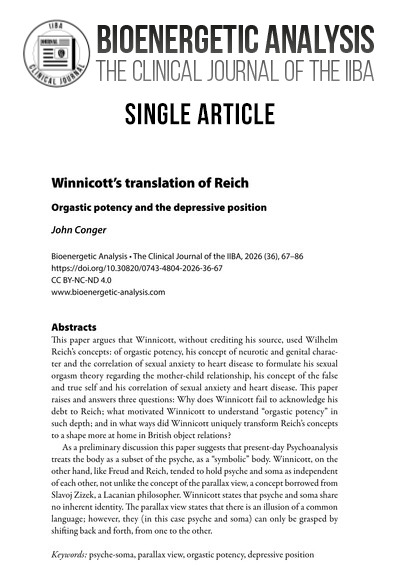
How to Cite
Conger, J. (2026). Winnicott’s translation of Reich: Orgastic potency and the depressive position. Bioenergetic Analysis, 36(1), 67–86. https://doi.org/10.30820/0743-4804-2026-36-67
Issue
Section
Articles
License

This work is licensed under a Creative Commons Attribution-NonCommercial-NoDerivatives 4.0 International License.
This work is licensed under the Creative Commons Attribution-NonCommercial-NoDerivatives 4.0 International License (CC BY-NC-ND 4.0). This license allows private use and unmodified distribution, but prohibits editing and commercial use (further information can be found at: https://creativecommons.org/licenses/by-nc-nd/4.0/). The terms of the Creative Commons licence only apply to the original material. The reuse of material from other sources (marked with a reference) such as charts, illustrations, photos and text extracts may require further permission for use from the respective copyrights holder.