
Adolescence and the clinical work of bioenergetics today
##plugins.pubIds.doi.readerDisplayName##:
https://doi.org/10.30820/0743-4804-2026-36-109关键词:
adolescence, embodiment, bioenergetic exercises, body psychotherapy, digital age, therapeutic intervention摘要
Embodied communication represents the primary form of expression when adolescents enter therapeutic settings. They arrive depleted, anxious, or constricted, presenting themselves for initial contact that initiates a journey of bodily self-discovery. By incorporating contemporary understanding of adolescent embodiment in the digital age, this clinical approach emphasizes body recognition and self-perception, valuing movement and understanding how this occurs within shared networks of virtual relationships, addressing associated pathologies such as fragmentation and derealization. This paper presents exercises adapted from Lowen and contemporary body therapies to demonstrate the importance of somatic work with adolescents. Clinical experience demonstrates that bioenergetics provides an essential therapeutic framework for developing integrative pathways that combine sensations, images, and emotions. This approach intensifies interpersonal affective registration, validates individuation, respects expressive boundaries, accommodates emotional fluctuation, and enhances the self-acceptance necessary for identity formation.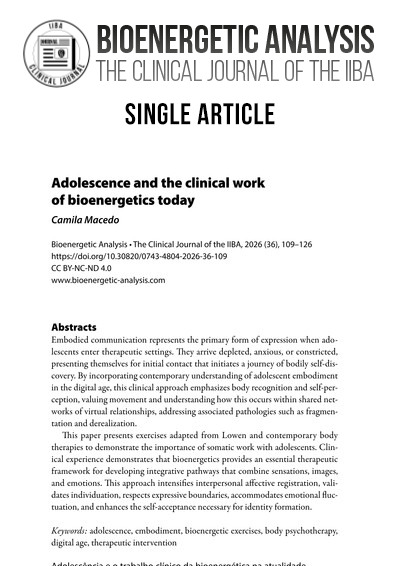
##submission.downloads##
##submission.howToCite##
Macedo, C. (2026). Adolescence and the clinical work of bioenergetics today. Bioenergetic Analysis, 36(1), 109–126. https://doi.org/10.30820/0743-4804-2026-36-109
期
栏目
Articles
##submission.license##
##submission.license.cc.by-nc-nd4.footer##This work is licensed under the Creative Commons Attribution-NonCommercial-NoDerivatives 4.0 International License (CC BY-NC-ND 4.0). This license allows private use and unmodified distribution, but prohibits editing and commercial use (further information can be found at: https://creativecommons.org/licenses/by-nc-nd/4.0/). The terms of the Creative Commons licence only apply to the original material. The reuse of material from other sources (marked with a reference) such as charts, illustrations, photos and text extracts may require further permission for use from the respective copyrights holder.